
What Is “Kafkaesque,” Exactly? (And Why Your Monday Morning Might Qualify)
Daffa Albari
Author
I recently came across the writing of Franz Kafka, and it left me with a strange sense of recognition I couldn’t quite shake. The way he described systems, confusion, and quiet frustration felt… uncomfortably familiar. I want to share a bit of that feeling with you — because chances are, you’ve already lived it.
Picture this: you need to submit a leave request. To submit a leave request, you need approval from your manager. To get your manager’s approval, you need to fill out a form. The form is on a portal. The portal requires a login. You don’t have a login. To get a login, you need to submit a request to IT. The IT request requires your employee ID. Your employee ID is on your contract. Your contract is in HR. HR is only available on Tuesdays between 10 and 11 AM, and this week they’re in a mandatory team-building workshop.
You just wanted to take a day off.
If reading that made your left eye twitch with recognition, congratulations — you have experienced something Kafkaesque. And also, I’m sorry.
Franz Kafka: A Quick Introduction for People Who Were Not English Majors

Franz Kafka was a Czech-Jewish writer born in Prague in 1883. He worked a 9-to-5 job — insurance, of all things — and spent his evenings and nights writing. He never finished most of his novels. He never saw most of them published. He reportedly asked his best friend Max Brod to burn all his manuscripts after he died.
Max Brod did not do that. Which is why we can read them today.
Kafka died of tuberculosis in 1924 at forty years old, which is genuinely sad and also explains a lot about the mood of his writing. His most famous works include The Metamorphosis (a man wakes up one morning and has become a giant insect — his family is mostly just inconvenienced by this), The Trial (a man is arrested and prosecuted for a crime no one will name, by a court no one can find, under laws no one will explain), and The Castle (a man tries to gain access to a mysterious castle and its authorities and never, ever does).
Notice a theme? No one knows what’s going on. The systems are enormous and incomprehensible. The individual is small, confused, and vaguely guilty for reasons he cannot identify. And everyone around him seems to find this perfectly normal.
That’s Kafka.
So What Does “Kafkaesque” Actually Mean?
You’ve probably heard the word thrown around. Someone’s insurance claim got denied for the fifth time and they call it Kafkaesque. A politician describes bureaucratic red tape as Kafkaesque. Your friend who got stuck in a customer service loop for three hours — transferred between departments, given different answers by different representatives, eventually disconnected — texts you: this is literally Kafkaesque.
They’re not wrong, exactly. But the word goes a little deeper than just “frustrating” or “bureaucratic nightmare.”
To call something Kafkaesque is to describe a specific flavor of existential disorientation — the feeling of being trapped inside a system that is vast, indifferent, and internally logical to everyone except you. The rules are real. The authority is real. The consequences are real. But the sense of it — the why and the how and the who to talk to — remains perpetually just out of reach.
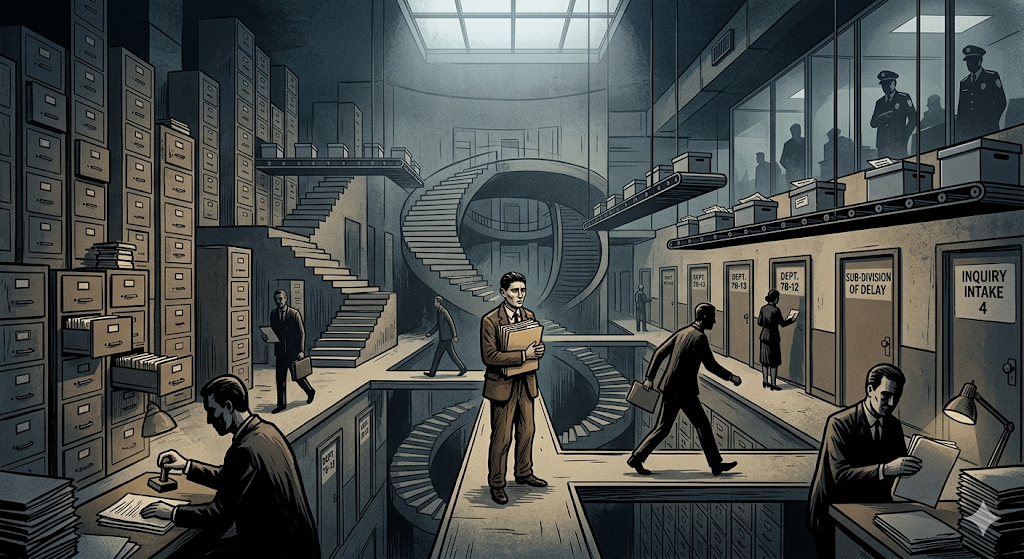
It’s not just that the system is broken. It’s that the system seems to be working exactly as intended, and you are the only one who finds this alarming.
In The Trial, Josef K. doesn’t stumble into a corrupted court. He stumbles into a court that functions — that has processes and clerks and lawyers and waiting rooms — but whose fundamental purpose is opaque, and whose logic he cannot access no matter how hard he tries. He keeps expecting someone to explain it to him. No one does. The terrifying part isn’t the injustice. It’s the normality of the injustice.
Why This Feels Uncomfortably Familiar If You’ve Ever Had a Job

Here is a thing I have done at an office: spent forty-five minutes in a meeting about the format of a meeting that would discuss the outcome of a previous meeting. No decisions were made. A follow-up was scheduled.
Here is another thing: submitted the same expense report three times because the system kept logging me out mid-submission without saving, and when I called support they told me to try clearing my cache, which did nothing, and then told me to use a different browser, which also did nothing, and then told me the system was “currently under maintenance” and would I like to call back tomorrow.
I did not feel like a giant insect. But I understood, viscerally, what Kafka was getting at.
The modern corporate structure — with its org charts and approval chains and compliance trainings and quarterly reviews that measure metrics that measure other metrics — is almost aggressively Kafkaesque. Not because anyone designed it to be cruel (probably), but because the machinery of large organizations tends, over time, to become its own justification. Processes exist because processes exist. Forms are required because forms are required. You need sign-off from someone who is out of office until Q3.
And the worst part — the most authentically Kafkaesque part — is that everyone around you seems to accept this as simply the way things are. Your colleague who has been there fifteen years just shrugs. That’s how it’s always been. The system is not broken. It is the system. You are the variable.
The Other Part of Kafka No One Talks About Enough: The Absurdity Is Kind of Funny
This is something that gets lost in translation when people invoke Kafka to describe Something Very Serious. His writing is, in places, darkly, almost uncomfortably comic. The Metamorphosis opens with a man waking up as a bug and his first thought — his very first thought — is that he’s going to be late for work. His boss will be angry. He had perfect attendance.
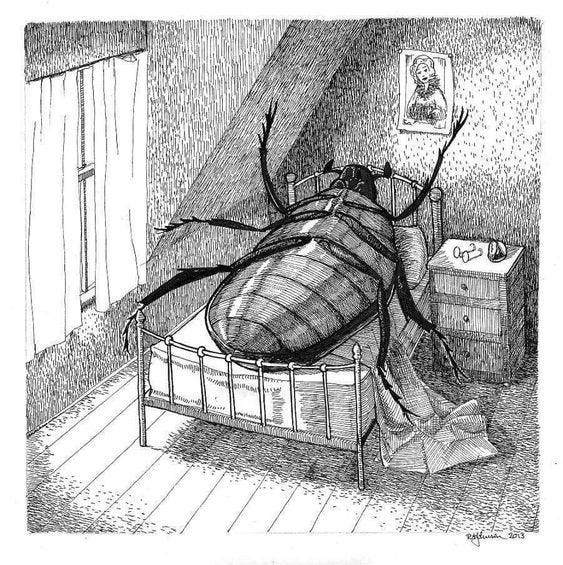
He is a giant insect. He is worried about his attendance record.
If that doesn’t describe the particular psychological trap of being a salaried employee, I don’t know what does. The internalization of the system’s logic even as the system has clearly failed you. The instinct, when everything is absurd, to focus on the one small thing you might still be able to control.
I once sat in a mandatory training about how to take mandatory trainings. I completed it on time. I got a little certificate.
What Kafka Was Really Saying (Or What I Think He Was Saying, Anyway)
Kafka’s world — the giant insect, the unknowable trial, the unreachable castle — is a metaphor for alienation. For the experience of living inside structures — bureaucratic, social, familial, existential — that are not built to accommodate the actual texture of being a human person. The rules were made somewhere, by someone, for reasons that have long since been absorbed into the architecture. And you, the individual, are left to navigate them with whatever dignity you can manage.
He wasn’t writing a how-to guide or a call to revolution. He was just, with devastating precision, describing how it feels. How small it feels. How quietly, persistently strange it is to wake up every morning and be expected to perform normalcy inside systems that are, if you look at them directly, pretty deeply irrational.
The fact that his name became an adjective is one of the more satisfying things that has ever happened in literary history. He spent his life feeling like an outsider to every institution he inhabited — his job, his family, his city, his own body. And now “Kafkaesque” is a word. It is in the dictionary. Somewhere there is probably a form to fill out to get it officially recognized, and I hope it required three rounds of revisions and a signature from someone who has been on sabbatical since 2019.
So What Do We Do With This?

Honestly? I’m not sure Kafka had a prescription. He was more of a diagnostician. Here is the thing, he seemed to be saying. Here is the shape of it. Doesn’t it look familiar? Aren’t you a little tired?
Maybe the usefulness of having a word like “Kafkaesque” is the same usefulness as any good diagnosis: at least now you know what you’re dealing with. At least when the portal logs you out for the fourth time, when the meeting about the meeting gets rescheduled, when you are told that your request cannot be processed because it was submitted on a Thursday and Thursdays are for a different department — you can name it.
This is Kafkaesque. This is the thing. I am not crazy. I am not the problem. The insect was also not the problem.
It doesn’t fix the system. But it might, just barely, preserve your sanity inside it. And then you close the laptop and go eat your knockoff Froot Loops and try again tomorrow.
Originally published on Medium
View original article →